How to choose a heat pump for your house without overpaying for electricity
Heat pump output should come from a heat loss calculation, not floor area. Here is what we look at when sizing a unit and what to ask an installer before you sign.
Every week someone asks: "I have 160 square metres, which heat pump do I need?" Our answer: it depends on the house, not the floor area. Two 160 m² houses can need 5 kW and 12 kW. Here is how we size them at Bielak & Sowa and what to ask any installer before you sign.
Start with heat loss, not "50 W/m²"
The "50 W per square metre" rule comes from the days of oversized boilers. With a heat pump, oversizing costs money.
We size the unit from a design heat load calculation to PN-EN 12831. We work through the building fabric (walls, roof, ground floor, windows), ventilation and thermal bridges at the design outdoor temperature. Poznań sits in climate zone II, so we calculate for -18 °C. If the house already exists and was heated with gas or coal, we also check actual fuel use over the last 2-3 seasons. The calculation and the bills should roughly agree.
Typical results from our jobs:
- new 150 m² house, well insulated, with heat recovery ventilation: 4-6 kW,
- 150 m² house from 2000-2010 with 10-12 cm of insulation: 7-9 kW,
- 1980s house after a partial retrofit: 9-12 kW.
Monoblock, split or ground source
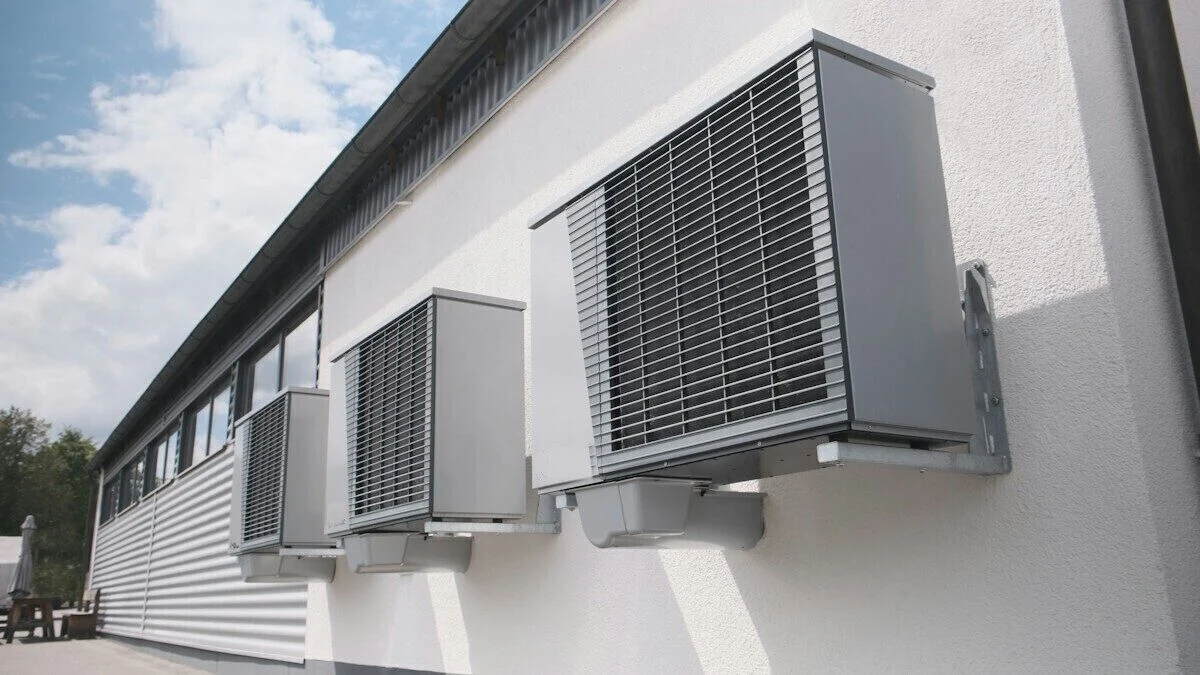
Air-to-water monoblock. The whole refrigerant circuit is sealed inside the outdoor unit and only water goes into the house. Installation is simpler, with no refrigerant brazing on site. The outdoor water pipes need frost protection (glycol or anti-freeze valves) and good insulation. It is our most common choice.
Air-to-water split. The outdoor unit connects to an indoor unit through refrigerant lines. Water never leaves the house, so there is no freezing risk. Installation needs F-gas certification, and the refrigerant line route needs proper planning.
Ground source (brine-to-water). The highest and most stable winter efficiency, quiet, no outdoor unit. Boreholes or a horizontal ground loop are expensive, though, and boreholes involve geological paperwork. It suits large houses with high demand, or plots where an outdoor unit cannot go.
An oversized pump is a problem too
At +5 °C, typical for most of the season, an oversized unit keeps switching on and off. This cycling wears the compressor, lowers efficiency and can be noisy. Inverter units modulate, but each has a minimum output. So we look at both the maximum output at -18 °C and the minimum output at +7 °C.
The bivalent point
This is the outdoor temperature below which the heat pump alone no longer covers the heat loss and an electric heater or second heat source tops it up. In Wielkopolska we usually set the bivalent point somewhere around -7 to -10 °C. Such days are rare, so the heater adds little to annual consumption, and a smaller pump runs better for the rest of the winter. Sizing "for -20 °C with no heater" usually ends with cycling in autumn and spring.
Radiators, underfloor heating and flow temperature
The water temperature in the system affects your bills more than the brand of the unit. Lower is better:
System | Typical flow temperature at -18 °C | Comment |
|---|---|---|
Underfloor heating | 30-35 °C | best conditions for a heat pump |
Large low-temperature radiators, or underfloor plus radiators | 40-45 °C | good, few compromises |
Old steel or cast iron radiators | 50-55 °C | works, but SCOP drops noticeably |
In older houses we often replace the 2-4 smallest radiators with larger ones. That costs less than one year's difference in running costs.
SCOP, not COP
The COP in a brochure applies to one operating point, for example +7 °C outdoors and 35 °C flow. SCOP is the seasonal figure for the whole year at a given flow temperature. Compare SCOP for the average (temperate) climate at the flow temperature your system will actually run at, 35 °C or 55 °C. The gap between those two values for the same unit can be large.
Noise and placement
Datasheets usually give sound power, not the sound pressure you hear a few metres away. So we calculate noise at specific points: under your bedroom window, under your neighbour's, and at the plot boundary. For detached housing the night-time limit is usually 40 dB(A). We do not put units in a recess between two walls, under a bedroom window or against the neighbour's wall on a narrow plot.
The unit has to sit on a bracket or feet above snow level, with room for the condensate drain and defrosting.
Refrigerant: R290 or R32
New monoblocks increasingly use R290 (propane). It has a very low GWP and can reach higher water temperatures, which helps in houses with radiators. It is flammable, so the manufacturer specifies a safety zone around the unit: no drains, basement windows or ignition sources nearby. R32 is still common, especially in splits, but EU F-gas rules are gradually restricting refrigerants with higher GWP.
Hot water tank
For 3-4 people, 200-250 litres is usually enough. With two bathrooms and a bath, go for 300. The coil inside the tank has to suit a heat pump, because a standard boiler tank has too little heat exchange surface. Once a week the water should be heated to 60 °C (anti-legionella cycle).
Subsidies and your choice of unit
If you use the Czyste Powietrze programme, the heat pump has to be on the ZUM list (the green devices and materials list). We check this before quoting: a model off the list gets no subsidy. Check the current rules on the Czyste Powietrze programme website.
Checklist before you sign
- Do you have a heat loss calculation for your house, not an estimate from floor area?
- What is the unit's output at -18 °C and its minimum output at +7 °C?
- Where is the bivalent point and how big is the backup heater?
- What will the flow temperature be at -18 °C? Do any radiators need replacing?
- What is the SCOP at that flow temperature?
- Where will the outdoor unit go and how loud will it be under the neighbour's window?
- How will condensate be drained?
- Are the outdoor pipes protected against freezing?
- Which hot water tank, and is the coil sized for a heat pump?
- Is the model on the ZUM list, if you are taking a subsidy?
- Who does the servicing and what does it cost?
We can come over, calculate the heat loss and show you the result in writing before we talk prices.