 Private specialist outpatient clinic
Clinic in Gniezno: heat recovery ventilation with cooling
- Noise in consulting rooms
- 31-34 dB(A) in spot checks, design target about 30-35 dB(A)
- Waiting room temperature in the July heat
- 24-25°C with 33°C outside
Service
Yearly servicing, repairs and service contracts for heat pumps, air conditioning and heat recovery ventilation.
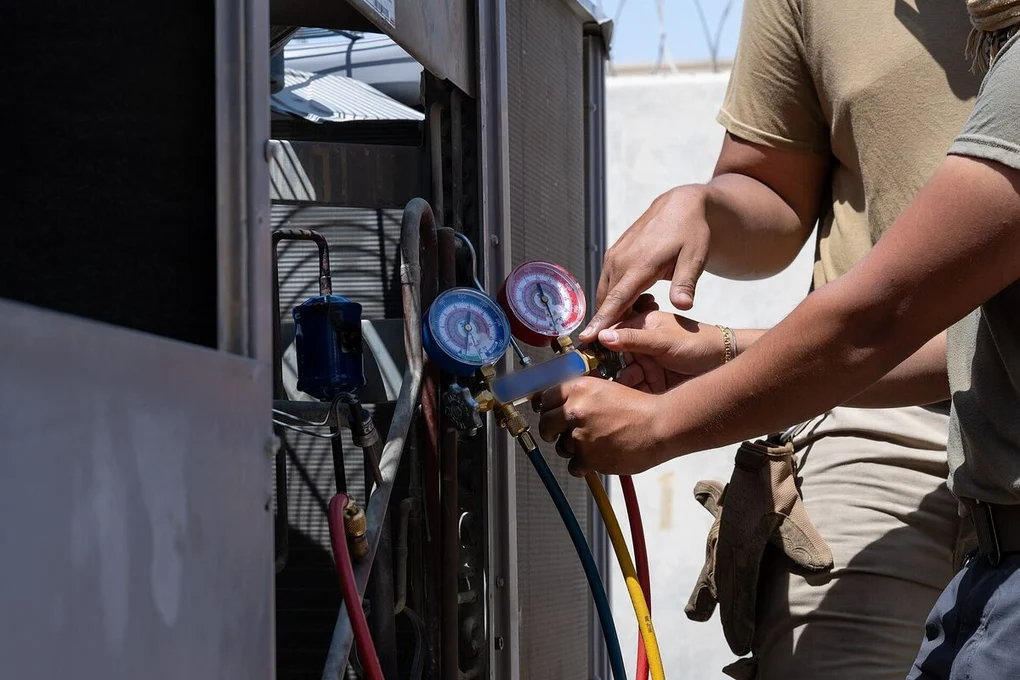
Service visits required to keep the manufacturer's warranty
Service contract: visit within 48 h in the heating season
Emergency cover October-April, daily 7:00-21:00
Leak checks in line with F-gas regulations
Service has been a separate department since 2019. It has its own dispatcher and 5 service vans, and makes about 3,400 visits a year in Poznań and the surrounding area. The department is run by Agnieszka Wróblewska. We handle:
Our own clients, and people whose equipment was installed by a company that has since closed or stopped answering the phone. In that case the first visit is longer, because we check the whole system, not only the unit.
Most heat pump and air conditioner manufacturers require a yearly service to keep the warranty valid. What the service finds matters more: a clogged water filter that lowers efficiency, a blocked condensate drain that freezes in winter, a pressure drop in the system or a badly set heating curve. Each of these pushes up electricity use before anything actually breaks.
A contract covers a yearly service on an agreed date, a guaranteed visit within 48 hours in the heating season and access to emergency cover from October to April, daily 7:00-21:00. For "no heating" calls we usually come the same day. We price contracts by the number of units and the distance from Poznań.
In Poznań and Poznań county we do not charge for travel. Further out we add a fixed zone rate, which we give you when booking. When we have several services in one area on the same day, we try to group them, which shortens the wait for a slot.
For out-of-warranty repairs you always get a quote before we start. The vans carry the most commonly replaced parts, such as temperature sensors, circulation pumps and filters, so we fix many faults on the first visit.
How we work
A site visit and a heat-loss calculation. We size the unit for the building, not the floor area.
We check which programme you qualify for and help you put the application together.
Our own crews, usually 2-4 days. Commissioning, heating curve set-up and a walkthrough.
A check after the first month and the yearly inspections the manufacturer warranty requires.
FAQ
Question not here? Write or call us, we reply within one working day.
Write to usYes, as long as parts and the manufacturer's documentation are available. The first visit usually takes longer, because we need to get to know the system. If the unit is under warranty, we check that a service by us will not affect it.
Reading fault codes and operating history, checking refrigerant circuit parameters, cleaning the water filter and evaporator, checking the condensate drain, system and expansion vessel pressure, electrical connections and heating curve settings. Finally, an entry in the warranty card and a written report.
A yearly service on an agreed date, a guaranteed visit within 48 hours in the heating season, access to emergency cover from October to April, and priority for no-heating calls. The price depends on the number of units and the distance.
Check whether the controller shows a fault code and whether a circuit breaker has tripped. Take a photo of the fault code. Then call the service line on +48 000 000 001. For no-heating calls we usually come the same day.
For a heat pump, before the heating season, in September or October. For air conditioning, in spring. Autumn slots fill up quickly, so contract clients get them first.
Case studies
Private specialist outpatient clinicBlog
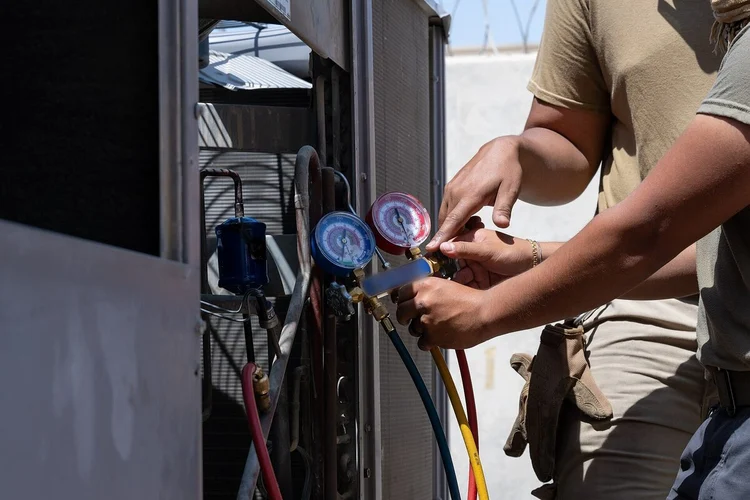
The checks a technician carries out during an annual heat pump or air conditioning service, and what manufacturer warranties and F-gas rules expect of you.
5 min read

Steam above the unit and frost on the fins are usually normal heat pump behaviour. Here is what we hear about on the service line during cold spells and which symptoms point to a real fault.
5 min read